Housing led by Country
Koodjal Booka means "Two Skins"
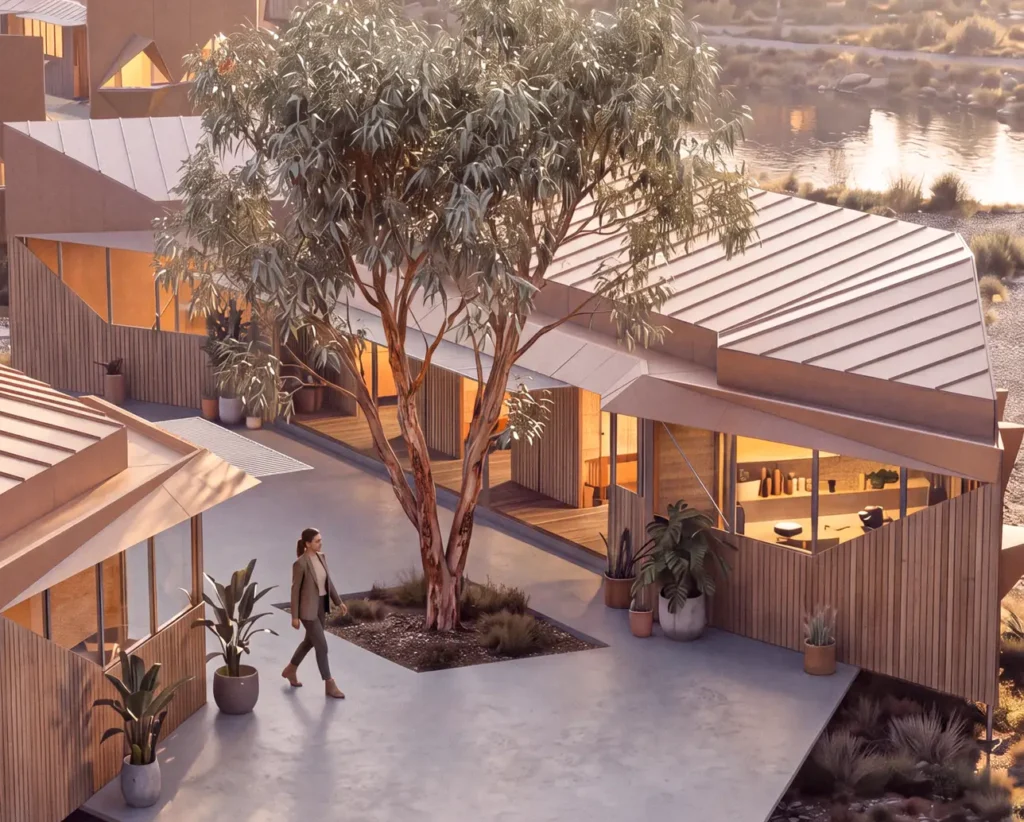
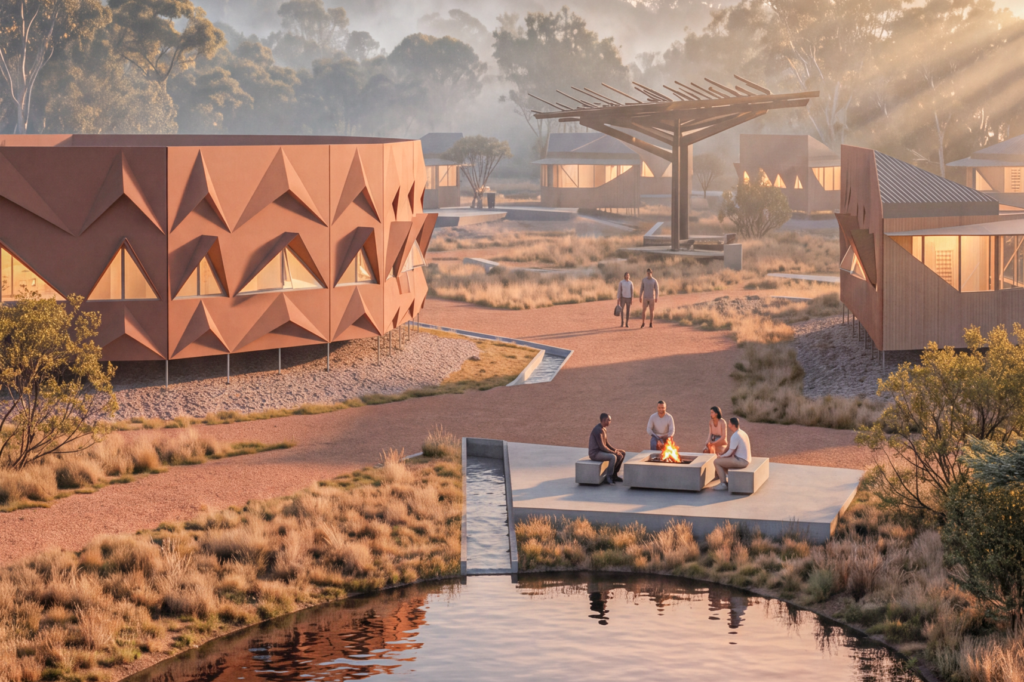
The concept of “two skins” establishes community as the starting point of the design process. The outer skin is formed first through relationships between family, gathering, shared space, movement and Country. These collective conditions create the social and spatial framework from which the architecture develops.
Within this framework, the inner skin provides the essential conditions of dwelling, including privacy, safety, shelter, climatic responsiveness and adaptability. The dwelling is not treated as an isolated object, but as a protected place within a wider network of relationships.
The space between the two skins is understood as a threshold. It mediates between personal retreat and collective life, allowing privacy and connection to coexist.

Design Begins with Listening
Co-Design
Community knowledge informs every stage of the design process, establishing an ongoing cycle of direction, testing and accountability.
Design Across Scales
From quantum to cosmic, Koodjal Booka understands architecture as a continuum of interconnected scales. Materials and construction establish the physical and environmental foundations of the project. Shelter and architecture translate these decisions into conditions for privacy, safety, comfort and adaptation. Community and urban design consider relationships between households, shared spaces and collective life. Country and geography situate the project within broader cultural, ecological and climatic systems.
These scales are not treated as separate disciplines or consecutive stages. Through one integrated collaborative design process, community knowledge connects decisions across every scale. Material detail, dwelling, settlement and Country inform one another, creating architecture that is coherent from its smallest component to its broadest relationship with place.